About Me

Yuzuki Yaguchi矢口 悠月(やぐち ゆづき)
Born in 2002 in Ishinomaki, Miyagi, Japan. He received his B.E. from the Department of Electrical and Electronic Systems, Faculty of Engineering, Saitama University, in 2025, and is currently a master's student at the Graduate School of Science and Engineering, Saitama University (Manabe Laboratory).
His interest lies in establishing an indoor navigation infrastructure that works in real-world public spaces. He currently studies indoor positioning, with a particular focus on Wi-Fi RTT (Round Trip Time) based methods.
History
| 2025.04 | Entered the Master's Program, Graduate School of Science and Engineering, Saitama University |
| 2025.03 | B.E., Department of Electrical and Electronic Systems, Saitama University |
| 2021.04 | Entered the Department of Electrical and Electronic Systems, Saitama University |
| 2020.03 | Graduated from Sendai Nika High School, Miyagi |
| 2002.03 | Born in Ishinomaki, Miyagi, Japan |
Publications & Presentations
Journal Papers
- Performance Evaluation of Wi-Fi RTT Lateration for Multi-floor Indoor Positioning Wi-Fi RTT Laterationにおける多階層屋内測位に向けた性能評価 IPSJ Journal, Vol.66, No.12, pp.1808–1826, Dec. 2025 (in Japanese; recommended paper).
Technical Reports & Presentations
-
A Study on Solution Algorithms Emphasizing Matrix Characterization in Wi-Fi RTT Lateration
Wi-Fi RTT Laterationにおける行列特性に注目した求解アルゴリズムの一検討
IPSJ SIG Technical Report, Intelligent Transport Systems and Smart Community (ITS), Vol.2025-ITS-101, No.56, pp.1–8, May 2025 (in Japanese).
Also published as Vol.2025-MBL-115 and Vol.2025-DPS-203 (joint SIG meeting). - A Study of Improving Positioning Performance of Wi-Fi RTT Lateration in Multi Floor Environments 多階層環境におけるWi-Fi RTT Laterationによる測位性能向上の一検討 IPSJ SIG Technical Report, Intelligent Transport Systems and Smart Community (ITS), Vol.2024-ITS-96, No.13, pp.1–6, Feb. 2024 (presented at the 96th meeting, 4 Mar. 2024, Nagasaki University; in Japanese).
An up-to-date list is also available on Google Scholar and researchmap.
Research Interests
Multi-floor indoor positioning with Wi-Fi RTT
GPS-based navigation offers high accuracy outdoors, but its accuracy degrades considerably indoors and underground, where satellite signals are attenuated and reflected. Improving the accuracy of indoor positioning is therefore an urgent problem, and a variety of methods based on wireless communication technologies have been studied. Among them, Wi-Fi based methods are attractive in practice because they require no dedicated hardware and can reuse existing communication infrastructure.
Fingerprinting, an absolute positioning method based on the received signal strength indicator (RSSI), is the mainstream approach for Wi-Fi indoor positioning. It determines the position by matching the RSSI values and the access point identifiers (BSSIDs) observed at positioning time against a database built in advance. While fingerprinting achieves very high accuracy, it is vulnerable to signal instability and external interference, and its performance degrades markedly under signal fluctuation. Wi-Fi RTT, standardized as IEEE 802.11mc in 2016, is a ranging technique that uses the round-trip time of signals between a smartphone and an access point, and has attracted attention for its accuracy.
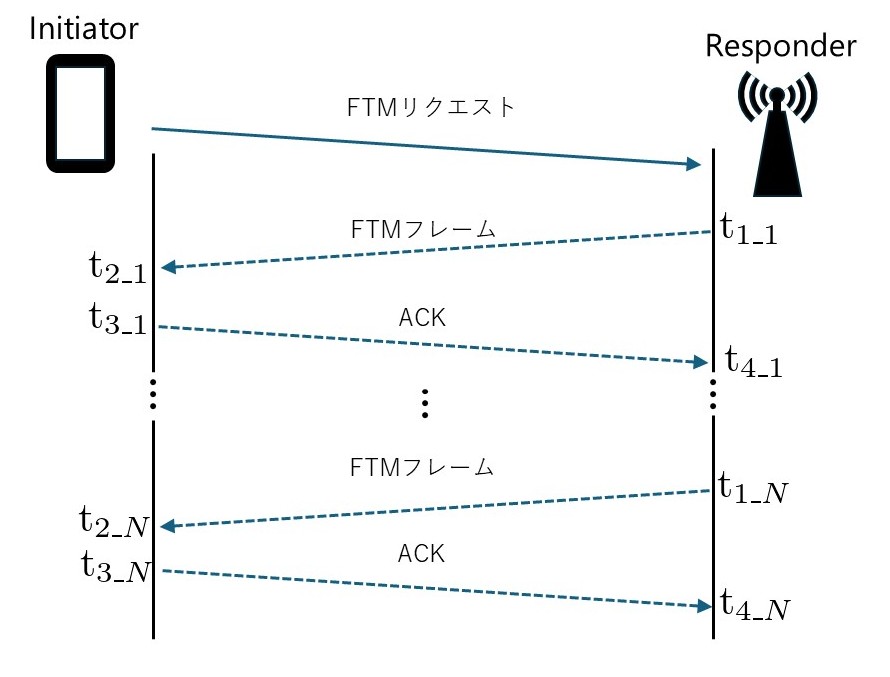
Most prior work on Wi-Fi RTT assumes a single-floor environment in which the access points and the terminal are placed on the same floor. Real environments, however, are not as simple as a laboratory: multi-floor structures, atrium spaces and dense human-body shadowing are intertwined and unevenly distributed. My work focuses on Wi-Fi RTT positioning in multi-floor environments, where access points and the terminal are separated by floors — a setting more realistic than that of prior work.
Higher accuracy in Wi-Fi RTT positioning would enable stable positioning in complex environments using Wi-Fi infrastructure alone, contributing to a universal navigation infrastructure for public spaces. In particular, it is directly relevant to improving accessibility and providing real-time location information in high-rise buildings, airports, railway stations and commercial facilities.
Awards
| 2025 |
Outstanding Presentation Award, 101st IPSJ SIG-ITS Meeting
For "A Study on Solution Algorithms Emphasizing Matrix Characterization in Wi-Fi RTT Lateration". |
| 2025 | SICE Superior Student Award, Society of Instrument and Control Engineers |
| 2024 |
Outstanding Paper Award, 96th IPSJ SIG-ITS Meeting
For "A Study of Improving Positioning Performance of Wi-Fi RTT Lateration in Multi Floor Environments". |
Contact
For research enquiries, please contact:
yuzuki[at]mnb.ees.saitama-u.ac.jp
([at] is used instead of @ to reduce spam.)
Laboratory: Manabe Laboratory, Saitama University
Department: Department of Electrical and Electronic Systems, Saitama University